
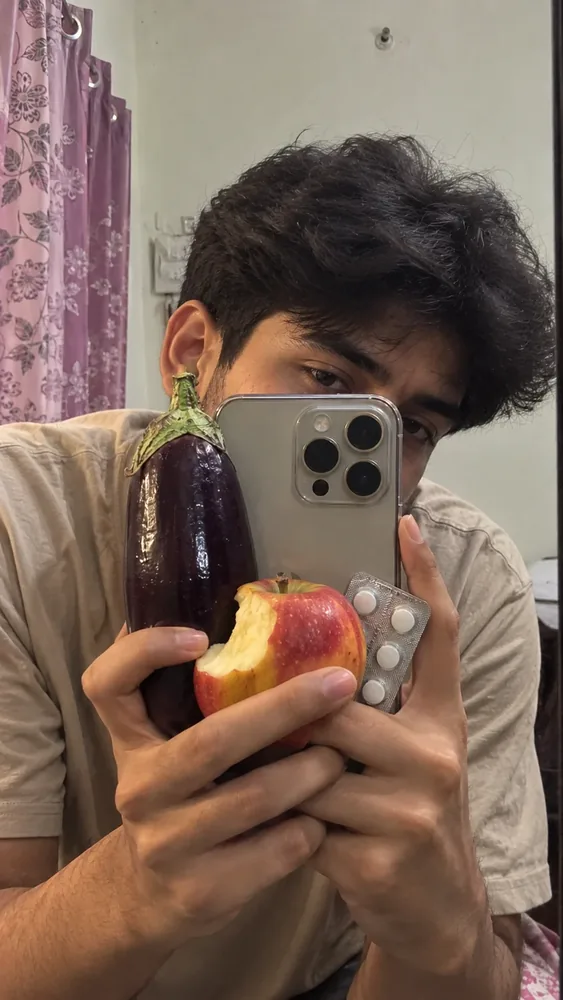
Trending Mirror Selfie Photo Prompt for Boys
Copy this selfie prompt below and paste it into ChatGPT with your own photo.
Use the uploaded reference image as the PRIMARY COMPOSITION REFERENCE.

Create an ultra-realistic close-up indoor mirror selfie photograph of a young [BOY/GIRL]. The final image must look like a genuine photograph captured casually on a smartphone, NOT an AI-generated image.

IMPORTANT:
Recreate the SAME overall composition, camera distance, framing, body position, phone position, object arrangement, hand placement, perspective and proportions as the reference image. Do not redesign the scene.

SUBJECT:
A young [Indian boy / Indian girl] standing extremely close to a mirror and leaning slightly forward toward it.

If a separate face reference is provided:
STRICT IDENTITY LOCK.
Preserve the person's exact facial identity, facial structure, eyes, eyebrows, nose, lips, jawline, skin tone, hairstyle, age and recognizable features. Do not beautify, reshape or replace the face.

The face is partially hidden behind the smartphone. Only the upper portion of the face/eyes and surrounding facial area should remain clearly visible, exactly as naturally happens in the reference composition.

POSE:
Match the reference pose precisely.

The subject's upper body is leaning toward the mirror.
Both arms/hands are positioned in front of the body.
One hand firmly holds the smartphone vertically.
The other hand supports and grips the objects against the phone.
The hands must overlap naturally in the lower portion of the image.

Do NOT create a normal selfie pose.
Do NOT separate the objects from the phone.
The phone and objects must form ONE tightly packed central composition.

SMARTPHONE:
A large modern premium smartphone is held vertically in the exact central position.

The BACK of the phone faces the mirror/camera.

The phone occupies the center of the frame and covers most of the subject's nose, mouth and lower face.

Use a large rectangular/square metallic camera island near the upper portion of the phone with three large camera lenses and one circular flash/detail, closely matching the reference phone appearance.

The phone must be physically behind the objects.

Realistic glass reflections, metallic texture, camera lenses, tiny scratches, fingerprints and natural smartphone surface reflections.

No warped phone.
No extra cameras.
No floating phone.
No incorrect perspective.

CRITICAL OBJECT ARRANGEMENT:

1. WHOLE PURPLE BRINJAL / EGGPLANT:
Place ONE whole fresh purple eggplant vertically along the LEFT SIDE of the phone.

The eggplant must be long, thick and glossy dark purple with realistic natural highlights.

Its green leafy stem/calyx must be clearly visible near the top.

The eggplant is pressed directly against the phone and partially overlaps the phone.

It must extend from approximately the upper-middle section of the phone down toward the lower-middle section.

The eggplant must NOT be floating beside the person.
It must be physically held tightly against the phone.

2. HALF-EATEN APPLE:
Place ONE red-and-yellow apple directly in front of the LOWER portion of the phone and eggplant.

The apple must be partially eaten/bite-marked on its LEFT/upper-left side.

IMPORTANT:
It must look like the apple has actually been bitten/eaten.
Show irregular natural bite marks and exposed pale cream-colored apple flesh.

Do NOT generate a whole untouched apple.

The apple should be approximately centered in the lower-middle portion of the phone.

Keep the apple large and clearly visible.

Its red/yellow skin must have realistic natural color variation, tiny pores, subtle bruising and glossy highlights.

Keep the small stem visible.

3. MEDICINE:
Include ONE small silver medicine blister strip near the apple/phone area, held naturally with the same hand.

The blister pack should be partially visible and physically pressed against/overlapping the phone and apple area.

Show several realistic round tablet pockets.

Do not make it oversized.
Do not make it the main focus.
It should appear as a small secondary object exactly within the cluster of objects.

HAND PLACEMENT:
The hands must tightly grip the phone, eggplant and bitten apple together.

Reproduce the reference hand arrangement:
- one hand wraps around the lower phone/object area
- fingers naturally cross over the apple
- thumb/fingers visibly support the apple
- other fingers hold the phone securely
- objects are pressed together rather than floating independently

Anatomically correct human hands.
Correct number of fingers.
Natural finger joints.
Realistic fingernails.
Natural wrinkles and skin creases.
Realistic skin pores.

Do NOT create extra fingers.
Do NOT merge fingers.
Do NOT create deformed hands.
Do NOT hide the entire hand behind the objects.

CLOTHING — BOY:
Use a simple beige/tan casual T-shirt with natural fabric folds, matching the reference style.

Natural short black slightly messy hair.
Optional natural beard/stubble.
No formal clothing.

CLOTHING — GIRL:
Use a simple beige/tan casual T-shirt or casual top with natural fabric folds.

Long natural dark hair if appropriate to the reference.
Keep the hairstyle realistic and slightly imperfect.

BACKGROUND:
Recreate the simple ordinary indoor environment from the reference.

Include a purple/pink floral-patterned curtain on one side.
Include a plain/textured light-colored wall.
Include subtle ordinary household details in the background.

Do NOT make the room luxurious.
Do NOT create a studio.
Do NOT add decorative objects that aren't present in the reference.

LIGHTING:
Natural indoor daylight coming from the side.

Strong realistic highlights on:
- hair
- skin
- phone
- eggplant
- apple

Natural soft shadows.
Realistic exposure.
Slight smartphone HDR.
No cinematic colored lighting.
No artificial glow.
No dramatic studio lighting.

CAMERA:
Vertical 9:16 photograph.

Extremely close smartphone mirror-selfie framing.

The subject's shoulders and arms fill most of the frame.

The phone/object cluster occupies the central vertical area.

The face/eyes appear behind and above the phone.

Use realistic smartphone wide-angle perspective.

Natural slight edge distortion.
Realistic mirror reflection.
Authentic smartphone computational photography.

IMAGE QUALITY:
Ultra-realistic 4K smartphone photograph.

Natural skin texture.
Visible pores.
Fine individual hair strands.
Realistic fabric texture.
Realistic apple skin.
Realistic eggplant skin.
Realistic metallic phone reflections.
Realistic medicine blister reflections.

Include subtle smartphone sensor noise, tiny compression artifacts and natural sharpening.

The image should NOT look excessively perfect.

PHOTOGRAPHIC STYLE:
Authentic candid smartphone photograph.
Real-life indoor lighting.
Natural imperfections.
No beauty filter.
No plastic skin.
No excessive skin smoothing.
No artificial bokeh.
No CGI.
No 3D-rendered appearance.
No illustration.
No cartoon.
No fantasy elements.

COMPOSITION LOCK:
The most important requirement is the OBJECT + PHONE + HAND composition.

Keep this exact visual hierarchy:

FACE / EYES
       ↓
PHONE CAMERA MODULE
       ↓
PURPLE WHOLE EGGPLANT + PHONE
       ↓
BITTEN HALF APPLE
       ↓
HANDS HOLDING EVERYTHING

The eggplant must remain on the LEFT side of the phone.
The bitten apple must remain in the LOWER CENTER.
The medicine blister must remain close to the apple/phone cluster.
The phone must remain vertically centered.
The hands must remain in the lower foreground.

Do not rearrange these objects.

FINAL RESULT:
A highly realistic viral Instagram-style mirror selfie that looks like an ordinary person spontaneously took the photograph at home.

It must be almost indistinguishable from a real smartphone photograph.

MATCH THE REFERENCE IMAGE'S:
- pose
- framing
- camera angle
- phone position
- eggplant position
- bitten apple position
- medicine position
- hand placement
- object scale
- lighting direction
- background arrangement
- overall visual proportions

Only change the subject from [BOY/GIRL] as requested while keeping the entire composition essentially identical.
Best with: ChatGPT
This selfie prompt turns an ordinary photo into a polished selfie image in a single generation. You get the same look you see above — no editing skills needed. It leans on natural daylight, a studio backdrop and a cinematic finish.
What this prompt creates
The instruction places the subject in a studio backdrop, lights them with natural daylight, finishes with a cinematic finish and frames it as a vertical 9:16 frame. At roughly 1180 words it is a detailed prompt, so expect the model to follow it closely — either way, the result stays recognisably you because the source photo drives the likeness.
How to use this selfie prompt
- Tap Copy prompt above to copy the full text.
- Open ChatGPT and start a new chat.
- Upload the photo you want to transform.
- Paste the prompt and send it.
- If the first result is not quite right, regenerate once or twice — small changes in wording shift the style a lot.
Tips for a better result
- Match the light. This prompt asks for natural daylight, so a source photo shot in similar conditions needs far less correction.
- Mind the background. It replaces your backdrop with a studio backdrop — a source photo with a plain or blurred background swaps over most cleanly.
- Shoot for the crop. The output is a vertical 9:16 frame, so leave headroom in your original rather than filling the frame.
- Start from the highest-resolution copy you have. Detail the model can see is detail it can keep.
- Crop before you generate. Removing clutter from the edges usually beats asking the model to remove it.
Who this selfie prompt suits
This one works especially well for Boys. It suits Instagram posts, profile pictures, and WhatsApp display photos, and it holds up on both phone and desktop screens.
More prompts like this
Browse every selfie prompt in this collection, or head back to the PromptPin homepage for the newest AI photo prompts. All of them are free to copy and use.
Want the theory behind the look? Read up on the golden hour.
What makes this selfie style work
Three things do most of the heavy lifting here. The lighting is described precisely rather than left to chance. The framing and camera angle are stated up front, which keeps the subject in proportion. And the finish — grain, contrast, and colour grade — is spelled out at the end, which is what separates a snapshot from something that looks deliberately shot.
You can reuse this structure for your own ideas. Keep the sentence order — subject, setting, lighting, camera, finish — and swap the descriptive words. Prompts written this way behave far more predictably than one long sentence.