
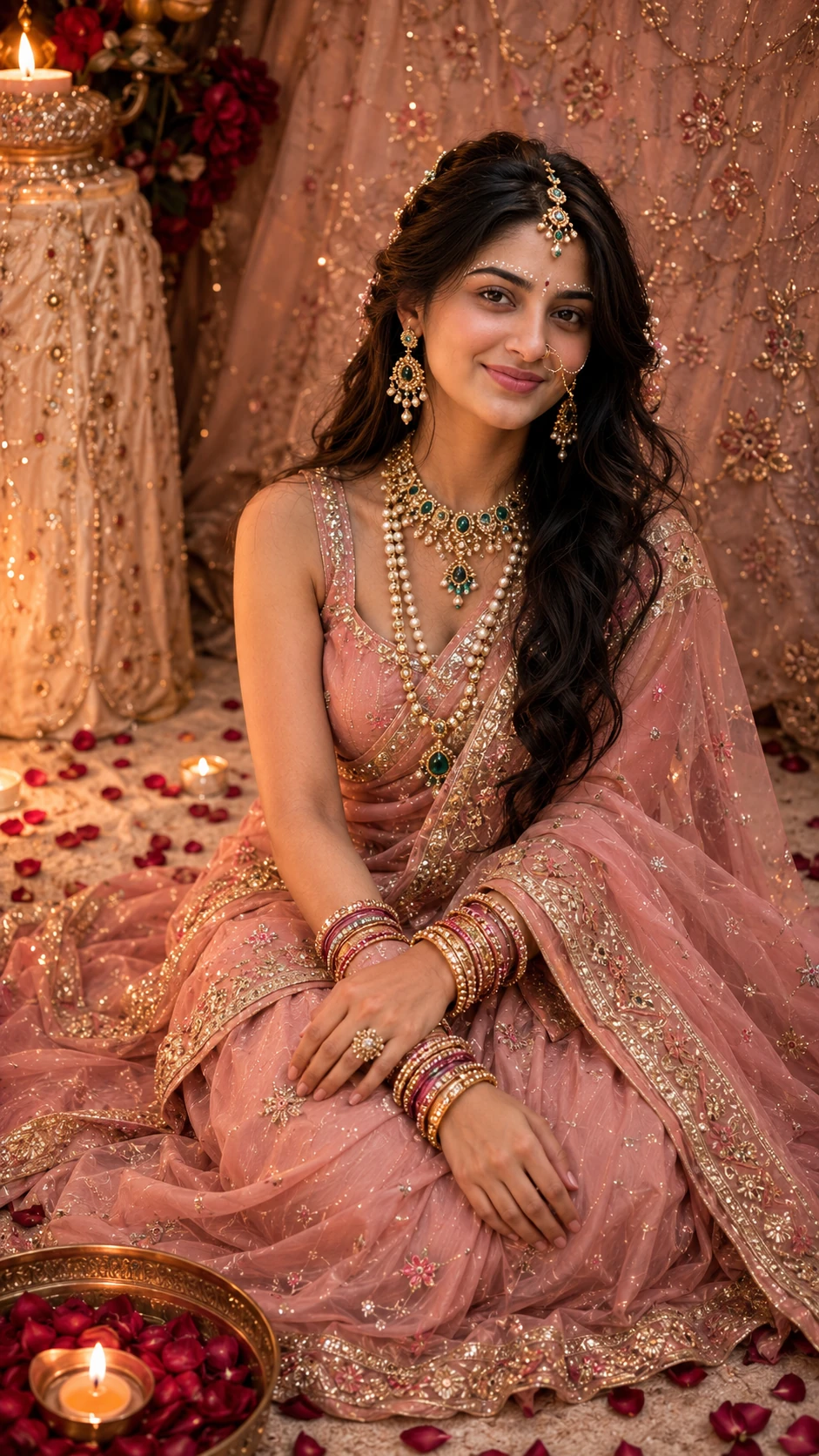
The story behind this one: most of this prompt is spent stopping the model from doing what it wants to do. Left alone, an AI asked for “Radha” will quietly slide the face toward a generic idealised look — slimmer, more symmetrical, somebody else — so the identity section here runs longer than the costume section. The Radha feeling is built entirely from things that sit on the face rather than change it: extended kajal, the row of small white dots above the bindi, jasmine in the hair, emerald and antique gold instead of red bridal gold. The dusty rose is deliberate too — the prompt explicitly rules out hot pink and red bridal, and that single restriction is what keeps it devotional rather than wedding-shoot.
Copy this photo prompt below and paste it into ChatGPT with your own photo.
Create an ultra-photorealistic vertical 9:16 luxury Indian devotional/festive portrait of a young woman styled as an elegant, traditional, ethereal representation of Radha, using the uploaded image ONLY as the facial identity reference.

CRITICAL INPUT RULE: The user will provide ONLY ONE IMAGE: a photograph of their own face. No other reference photograph will be provided. Therefore, everything other than facial identity must be recreated entirely from this written description.

The uploaded face controls ONLY the identity of the woman. Recreate the hairstyle, facial makeup, expression, pose, clothing, jewelry, environment, lighting, composition and photographic aesthetic entirely according to this prompt.

The final result should feel unmistakably Radha-inspired — graceful, devotional, feminine, traditional, serene and ethereal — while remaining a realistic photograph of the person in the uploaded face image.

1. ABSOLUTE FACIAL IDENTITY LOCK

Use the uploaded user's face as the sole source of facial identity. Preserve the person's exact face shape, facial proportions, forehead, eyebrow structure, eye shape and spacing, eyelids, nose bridge and nose tip, nostrils, cheek structure, cheekbones, lips, cupid's bow, chin, jawline, natural facial asymmetry, skin tone and distinctive facial characteristics.

The final woman must unmistakably be the same person as the uploaded face.

Do NOT create the face of a generic Indian model. Do NOT invent a different Radha face. Do NOT blend the user's face with another woman's face. Do NOT alter the user's facial proportions to make them look like a stereotypical Indian beauty. Do not make the face unnaturally slimmer, wider, longer, shorter or more symmetrical. Do not change the user's eye shape, nose, lips or jawline.

Radha-inspired styling must be achieved through makeup, hair, jewelry, expression, costume and atmosphere, not by replacing or reshaping the user's identity.

2. RADHA-INSPIRED VISUAL IDENTITY

The woman should evoke the traditional visual feeling associated with Radha: soft, divine, graceful, youthful, compassionate, romantic, devotional, serene and feminine. She should not look like a modern fashion model wearing Indian clothing. She should feel like a timeless Radha-inspired Indian devotional portrait. The beauty should be understated and elegant rather than glamorous in a contemporary Bollywood fashion-shoot style.

Her expression should communicate serenity, devotion, tenderness, quiet confidence, gentle romantic warmth and spiritual calm. Her eyes should be the emotional focal point of the portrait.

3. RADHA-INSPIRED FACIAL MAKEUP

Apply traditional North Indian/Radha-inspired festive makeup while preserving the user's exact facial structure. The complexion should be naturally luminous and warm. Keep realistic skin texture visible. Use soft, refined makeup rather than heavy modern contouring.

Eyes: make the eyes expressive and graceful using softly extended black kajal, thin traditional eyeliner, subtle warm brown/rose eyeshadow, naturally defined lashes, softly highlighted inner corners and gentle lower-lash definition. The kajal should slightly elongate the visual appearance of the eyes in a traditional Indian manner without changing the actual eye shape. The eyes should have the characteristic soft, soulful, devotional quality associated with traditional Radha imagery.

Eyebrows: preserve the user's natural eyebrow identity. Groom them elegantly but do not dramatically reshape them. They should remain expressive and naturally defined.

Bindi / forehead: add a small, elegant traditional red/maroon bindi centered naturally on the forehead. Above the eyebrows, add a delicate decorative arrangement of tiny white ornamental dots, carefully placed symmetrically but naturally. These tiny white dots should be clearly visible and form an elegant traditional Indian/Radha-inspired forehead decoration. Do not make the dots oversized. They should look like finely applied traditional decorative makeup rather than stickers or digital symbols. Add subtle red/maroon decorative details around the central forehead area where appropriate.

4. RADHA-INSPIRED HAIRSTYLE — VERY IMPORTANT

The hairstyle should be one of the strongest elements making the woman feel like Radha. Give her very long, thick, naturally dark black/brown hair with a traditional Indian devotional aesthetic. Hair should be extremely soft and feminine, naturally voluminous, long and flowing, thick through the lengths, gently wavy rather than perfectly straight, partially gathered toward the back and softly framing the face.

Create a traditional Radha-inspired half-up hairstyle. The crown should have controlled natural volume. The front hair should be neatly parted, with some soft tendrils deliberately falling around the face. Include two or three fine, naturally curved face-framing strands, especially one loose curved strand falling beside the cheek. The rest of the long hair should cascade naturally behind the shoulders and down the back.

Incorporate delicate traditional floral decoration into the hair, especially small white jasmine flowers (gajra) arranged elegantly toward the back/side of the hairstyle. The floral decoration must be subtle and luxurious rather than oversized. Add a delicate jeweled hair ornament/maang-tikka chain integrated naturally into the parting.

Hair should resemble an elegant traditional Radha-inspired devotional hairstyle, not a contemporary bridal bun or salon hairstyle. Individual hair strands must be visible and photorealistic.

5. RADHA-INSPIRED HEAD JEWELRY

Place an elaborate but delicate traditional Indian maang tikka in the center of the forehead. The jewelry should feature antique gold, pearls, emerald-green stones and small white sparkling stones. A delicate jeweled chain follows the hair parting. The central pendant rests naturally above the bindi/forehead area. Add subtle side hair jewelry following the natural shape of the hairstyle. The overall effect should resemble traditional Radha iconography interpreted as an ultra-realistic luxury photographic portrait.

6. RADHA-INSPIRED JEWELRY

Use elaborate traditional Indian jewelry, but keep it graceful rather than excessively modern or bridal-heavy.

Earrings: large traditional gold jhumka/chandelier earrings with emerald-green stones, pearls, tiny white stones, delicate gold filigree and dangling elements.

Nose ring: add a delicate traditional gold nath. It should be elegant and relatively refined. A very fine chain may connect the nath toward the ear. The jewelry must conform naturally to the user's actual nose without modifying the nose itself.

Necklaces: create several layered traditional necklaces. The main necklace should feature emerald green, antique gold, pearls and white stones. Include one shorter necklace close to the neck and several progressively longer layers. Add a prominent emerald pendant near the center of the chest. The necklaces should feel rich and traditional but not like an exaggerated modern bridal jewelry advertisement.

Bangles: both wrists should contain elegant stacks of thin gold bangles, emerald-green bangles, pearl/white-stone bangles and delicate antique-gold bracelets. Add an ornate traditional ring on one hand.

7. OUTFIT — RADHA-INSPIRED PINK ENSEMBLE

Dress the woman in an exquisite dusty rose / muted blush-pink traditional Indian saree, inspired by the soft colors commonly associated with Radha imagery. The saree should have luxurious lightweight fabric, subtle translucent quality, soft satin-like sheen, antique-gold embroidery, delicate floral motifs, an intricate traditional border, fine beadwork and subtle sparkling embellishments. The color must remain a sophisticated dusty rose-pink, not bright hot pink. The saree should look extremely expensive and handcrafted.

8. BLOUSE

Use a matching dusty-rose sleeveless traditional blouse. The blouse should be fitted but elegant, with broad delicate shoulder straps, a traditional feminine cut, subtle sheen, minimal embroidery and a refined neckline. Keep a natural portion of the midriff visible.

9. SAREE DRAPING

The saree should be draped traditionally and elegantly. The pallu should cross over one shoulder and fall diagonally across the front of the body. It should then flow naturally across her lap and spread onto the floor. The ornate border should remain clearly visible. Create numerous realistic folds and overlapping layers. The fabric should pool naturally around her seated body. The lower portion of the image should contain a large flowing spread of dusty-rose saree fabric with an ornate gold border.

10. RADHA-INSPIRED POSE

The woman is seated gracefully on the floor with her legs folded beneath the flowing saree. Her body is turned slightly diagonally toward the camera. Her back is upright but relaxed. Her shoulders are soft and naturally lowered. Her head is tilted very slightly and gracefully toward one side, creating a gentle, contemplative expression. She looks directly toward the camera with soft, soulful eyes. Her expression is peaceful and tender, with only the faintest hint of a smile.

One arm rests naturally across her lap. One hand lies softly over the saree in front of her. The other forearm rests lower across the lap, with the second hand gently placed over the flowing fabric. Both hands should appear relaxed and elegant.

Avoid a stiff model pose. Avoid an exaggerated fashion pose. The body language should communicate grace, modesty, devotion and feminine serenity. The pose should feel like a moment of quiet contemplation in Radha's world.

11. RADHA-LIKE EXPRESSION

The woman's expression should be serene, loving, devotional, gentle and slightly dreamy. Her eyes should feel emotionally expressive. Avoid a broad smile. Avoid a seductive expression. Avoid an aggressive fashion-model expression. Avoid an overly dramatic Bollywood expression. The expression should feel timeless and spiritual.

12. BACKGROUND — RADHA'S FESTIVE ENVIRONMENT

Place her in an intimate, luxurious traditional Indian devotional/festive setting. The background consists of flowing cream, champagne, beige and blush-pink fabrics decorated with tiny sequins, pearl-like embellishments, delicate floral motifs, ornamental dotted patterns and subtle gold embroidery. The fabrics are loosely draped behind her with natural folds.

The setting should feel like an elegant traditional Indian celebration associated with Radha-Krishna devotional aesthetics, without becoming a temple interior. Do not show a literal deity statue. Do not turn the image into a religious painting. The woman herself is the central subject.

13. FLOWERS

Incorporate subtle traditional flowers around the environment and hairstyle: white jasmine flowers, soft pink flowers and red/pink rose petals. White jasmine should be particularly visible in the woman's hairstyle. Scatter natural red and deep-pink rose petals around the floor and saree. The flowers should feel naturally placed, not artificially arranged.

14. CANDLELIGHT

Include several small traditional candles/diyas around the scene. One prominent warm candle/diya should appear toward the lower-left foreground inside a shallow brass/gold decorative bowl containing red rose petals. Additional warm candlelight should appear subtly around the scene. The flames should create beautiful warm reflections on jewelry, skin, saree and surrounding fabric.

15. LIGHTING

Use an extremely warm, soft and romantic candlelit Indian devotional atmosphere. Main palette: warm amber, rose pink, antique gold, cream, emerald green and deep red. The woman's face should be beautifully illuminated but not overexposed. Her eyes must remain extremely clear and detailed. Jewelry should catch tiny warm highlights. Create realistic soft shadows. Add subtle warm light reflected from candles and surrounding fabrics. The lighting should feel like a real photograph captured during an intimate Indian festive evening.

16. CAMERA

Vertical 9:16. Professional full-frame camera photography. Approximately 50mm portrait perspective. Slightly elevated camera position relative to the seated woman. Natural perspective. No wide-angle distortion. No fisheye effect. No extreme close-up. Keep the entire elegant seated composition visible — head, shoulders, torso, both arms, both hands, seated body, flowing saree, floor, flowers and candles. The woman's face remains the primary focal point while the environment provides context.

17. PHOTOREALISM

Make this look like a genuine photograph taken by a professional Indian fashion/bridal photographer. Absolutely realistic skin pores, natural complexion, subtle facial texture, individual eyelashes, individual hair strands, realistic fabric fibers, realistic embroidery, realistic gemstones, physically accurate jewelry reflections, realistic hands, anatomically correct fingers, realistic shadows, realistic candle flames and natural depth of field.

Do not make the woman look like a digital illustration of Radha. She should look like a real human woman photographed in a Radha-inspired setting.

18. FINAL VISUAL TARGET

The final image should immediately communicate: "A real woman, with the exact face from the uploaded photograph, portrayed as an ethereal traditional Radha-inspired Indian beauty." The first impression should be Radha-like, graceful, devotional, feminine, traditional, ethereal, luxurious and photorealistic — not modern bridal model, fashion shoot or generic Indian woman.

ABSOLUTE NEGATIVE PROMPT

Do not create a generic model. Do not change the user's facial identity. Do not blend faces. Do not invent another person's facial features. Do not alter eye shape. Do not alter nose shape. Do not alter lips. Do not alter jawline. Do not make the face unnaturally symmetrical. Do not excessively smooth skin. Do not create plastic skin. Do not make her look like a CGI deity. Do not make her look like a painting. Do not create a cartoon or illustration. Do not use a modern Bollywood fashion pose. Do not use a seductive pose. Do not use a standing pose. Do not remove the jasmine flowers. Do not remove the maang tikka. Do not remove the white decorative forehead dots. Do not remove the bindi. Do not remove the nath. Do not remove the emerald jewelry. Do not replace the dusty-rose saree. Do not change the saree into red bridal clothing. Do not use a palace or generic wedding-hall background. Do not use cold studio lighting. Do not create distorted hands. No extra fingers. No missing fingers. No fused fingers. No malformed jewelry. No floating jewelry. No impossible fabric folds. No exaggerated beauty filter. No contemporary fashion aesthetic.

PRIORITY ORDER

1. Exact user facial identity
2. Radha-inspired face, hair, makeup and expression
3. Graceful Radha-inspired pose
4. Traditional pink, gold and emerald costume
5. Devotional/festive environment
6. Ultra-photorealistic photography
7. Vertical 9:16 composition

The final image must look like the actual person from the uploaded face photograph has been naturally photographed as an ethereal Radha-inspired Indian woman, rather than a generated woman who merely resembles the user.
Best with: ChatGPT
This photo prompt turns an ordinary photo into a polished festive days image in a single generation. You get the same look you see above — no editing skills needed. It leans on soft studio lighting, an outdoor setting and a soft pastel palette.
What this prompt creates
The instruction places the subject in an outdoor setting, lights them with soft studio lighting, finishes with a soft pastel palette and and frames it as a vertical 9:16 frame. At roughly 2174 words it is a detailed prompt, so expect the model to follow it closely — either way, the result stays recognisably you because the source photo drives the likeness.
How to use this photo prompt
- Tap Copy prompt above to copy the full text.
- Open ChatGPT and start a new chat.
- Upload the photo you want to transform.
- Paste the prompt and send it.
- If the first result is not quite right, regenerate once or twice — small changes in wording shift the style a lot.
Tips for a better result
- Match the light. This prompt asks for soft studio lighting, so a source photo shot in similar conditions needs far less correction.
- Mind the background. It replaces your backdrop with an outdoor setting — a source photo with a plain or blurred background swaps over most cleanly.
- Shoot for the crop. The output is a vertical 9:16 frame, so leave headroom in your original rather than filling the frame.
- Try it twice. Image models are random — a second run often looks noticeably better.
- Start from the highest-resolution copy you have. Detail the model can see is detail it can keep.
Who this festive days prompt suits
This one works especially well for Girls. It suits Instagram posts, profile pictures, and WhatsApp display photos, and it holds up on both phone and desktop screens.
More prompts like this
Browse every festive days prompt in this collection, or head back to the PromptPin homepage for the newest AI photo prompts. All of them are free to copy and use.
What makes this festive days style work
Three things do most of the heavy lifting here. The lighting is described precisely rather than left to chance. The framing and camera angle are stated up front, which keeps the subject in proportion. And the finish — grain, contrast, and colour grade — is spelled out at the end, which is what separates a snapshot from something that looks deliberately shot.
You can reuse this structure for your own ideas. Keep the sentence order — subject, setting, lighting, camera, finish — and swap the descriptive words. Prompts written this way behave far more predictably than one long sentence.